Mastering Visual Complexity: Unlocking Innovation with Phoeniks Typography
Breaking the Mold of Standard Digital Design
In the current landscape of digital design, the challenge is no longer simply legibility; it is distinctiveness. Designers and brand strategists frequently find themselves trapped within the confines of geometric sans-serifs that, while functional, often lack the personality required to tell a complex story. The goal for many modern creators is to forge an identity that feels technical, forward-thinking, and deeply custom. However, achieving this level of uniqueness often requires modifying standard typefaces extensively, a process that can be time-consuming and technically difficult. This is where the need arises for a typeface that is inherently architectural and structurally unique. Phoeniks emerges as a specialized solution designed to bridge the gap between readability and high-concept aesthetics, offering a built-in complexity that standard fonts cannot match.
When a brand aims to convey innovation—whether in the tech sector, the gaming industry, or high-fashion apparel—the typography must act as a visual metaphor for that ambition. Generic fonts often fail to convey the "engineered" feel that these industries demand. Phoeniks addresses this by introducing a visual language that feels constructed rather than merely written. It is not just a typeface; it is a design system that leverages negative space to create a sense of depth and motion. For the designer seeking to solve the problem of "genericism," Phoeniks provides the tools to create a visual impact that resonates with a futuristic, almost runic aesthetic.
The Architecture of Phoeniks: Understanding the Anatomy
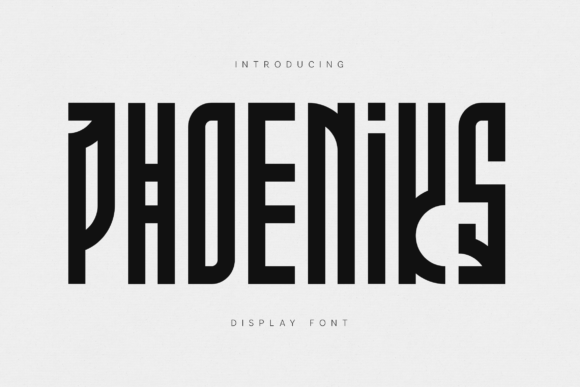
To effectively utilize a tool, one must understand its construction. Phoeniks is defined by its mastery of negative space and its distinct structural choices. Unlike traditional serif or sans-serif fonts that rely on uniform strokes, Phoeniks utilizes architectural stems and unique notched letterforms. These notches are not merely decorative; they serve a functional purpose by creating rhythm and texture within the text block. This specialized display font is characterized by a tall x-height, which gives the characters a commanding presence on the screen or page.
The interlocking character shapes found within Phoeniks allow for a fluidity that is rare in technical typefaces. When letters are placed side by side, they do not stand as isolated islands; rather, they interact to form a cohesive visual mass. This is crucial for wordmarks, where the relationship between letters is as important as the letters themselves. The "runic" quality of Phoeniks comes from these deliberate cuts and angles, evoking a sense of ancient wisdom reinterpreted through a futuristic lens. By understanding these anatomical features, designers can move beyond simple typesetting and begin to use Phoeniks as a sculptural element in their layouts.
Practical Applications: Where Phoeniks Excels
Identifying the correct context for a specialized font is key to successful implementation. Phoeniks is not intended for long-form body text; rather, it is a powerhouse for display applications where impact is the primary goal. Its utility spans several specific industries, each with unique visual requirements that Phoeniks is uniquely equipped to handle.
Technology and UI Design
In the realm of technology and experimental UI design, clarity must coexist with innovation. Phoeniks offers a solution for interfaces that need to feel advanced and "smart." The architectural nature of the font suggests precision engineering, making it ideal for dashboards, data visualization headers, or the branding of SaaS (Software as a Service) products. When used in UI design, it provides a stark, technical contrast to the clean lines of minimal layouts, acting as a focal point that draws the user's attention to key data points or navigation elements.
Sci-Fi Book Covers and Media
For authors and publishers in the science fiction genre, the cover art is the first promise made to the reader. Phoeniks delivers the necessary futuristic aesthetic without relying on clichéd "space age" tropes. Its unique notched letterforms suggest a language evolved over centuries or a technology far beyond current capabilities. Utilizing Phoeniks for titles and author names helps establish the genre immediately, signaling to the reader that the content within is speculative, complex, and immersive.
Futuristic Apparel Branding
The fashion industry, particularly the streetwear and techwear sectors, thrives on branding that feels exclusive and edgy. Phoeniks provides the visual complexity required for apparel logos that need to look good on fabric, tags, and digital storefronts. The interlocking shapes and tall x-height create a strong silhouette that holds up well in embroidery and screen printing. For brands looking to position themselves at the intersection of fashion and technology, Phoeniks offers a typographic voice that is bold, technical, and entirely custom.
Forging a Path of Visual Complexity
The true power of Phoeniks lies in how it manipulates negative space to create visual complexity without visual clutter. In design, negative space is the area around and between the subject of an image. Phoeniks treats this space as an active design element. The notches and cuts in the letterforms allow the background to penetrate the text, creating a dynamic interplay between figure and ground. This technique adds a layer of sophistication to wordmarks, making them feel more like logos than simple text.
For designers struggling with wordmarks that feel flat or uninspired, Phoeniks offers a way to add dimension and texture. The architectural stems give the letters a sense of structural integrity, as if they were built from concrete or steel. This physicality is essential for brands that want to project stability and strength while simultaneously embracing a futuristic vision. By choosing Phoeniks, a designer is not just selecting a font; they are adopting a visual philosophy that prioritizes structure, space, and innovation.
Implementation Strategies for Different Users
Different creative professionals will approach Phoeniks with different objectives. A logo designer, for instance, will likely focus on the spacing and kerning of the letters to ensure the interlocking shapes form a perfect, balanced monogram. They may spend time adjusting the tracking to allow the negative space to breathe, ensuring the design remains legible even with the complex letterforms.
Conversely, a web designer might use Phoeniks exclusively for H1 headers or hero section call-to-actions. In this context, the font serves as a visual anchor, immediately establishing the site's tone as technical and modern. They might pair Phoeniks with a clean, neutral sans-serif for body text to ensure readability while allowing Phoeniks to handle the heavy lifting of brand expression. The key consideration here is balance; because Phoeniks is visually dense, it requires ample space to shine without overwhelming the viewer.
Tips for Maximizing Impact
- Contrast is Key: Pair Phoeniks with minimal, clean elements. Because the font is complex, the surrounding design should be simple to avoid visual competition.
- Color and Texture: Experiment with metallic gradients or textured backgrounds. The architectural stems of Phoeniks catch light and shadow well, enhancing the 3D effect of the notched letterforms.
- Scale Matters: Use Phoeniks at large sizes. The intricate details of the negative space and notches can be lost at small sizes, so it is best reserved for headlines and display text.
Conclusion: The Future of Display Typography
In a digital world saturated with uniformity, Phoeniks stands out as a testament to the power of specialized design. It solves the problem of generic branding by providing a tool that is inherently technical, innovative, and visually arresting. Whether you are designing a logo for a tech startup, laying out a cover for a dystopian novel, or branding a cutting-edge fashion line, Phoeniks offers a pathway to a visual identity that is truly unique. By mastering the art of negative space and embracing the architectural nature of this font, designers can forge a path of visual complexity that captivates and endures.